Software licensing that survives contact with real users
A licensing system has two jobs: stop unlicensed use and stay out of the way of people who paid. Most designs only think about the first.
Les articles sont publiés en anglais.
Licensing failures rarely make the news. They appear as support tickets from paying customers who cannot open your program on a Monday morning. A good design starts by asking what must keep working when something goes wrong.
Sign the licence
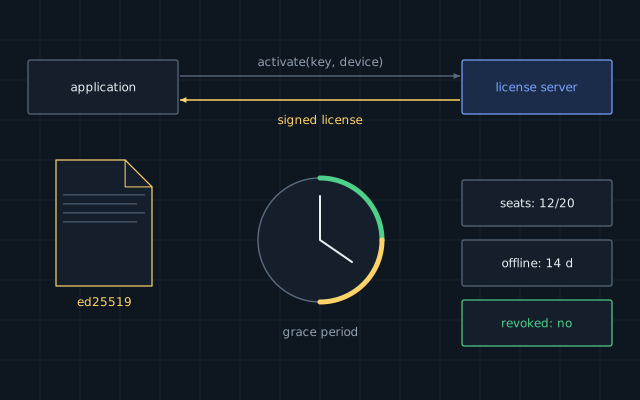
A licence should be a small file or token stating who may use what, until when, on which device. The vendor signs it with a private key that never leaves the licensing server. The application carries only the public key, so it can verify a licence but cannot create one.
Use a standard signature scheme such as Ed25519 through a well-reviewed library. Do not invent your own format of cryptography, and never embed a shared secret in the application: anyone with a debugger will find it.
Bind it, gently
Binding a licence to a machine stops a single file from being copied around an entire company. Base the identity on several hardware attributes and tolerate small changes. People replace disks and network cards, and virtual machines change their identifiers. If one changed component breaks the licence, you have written a support problem into the product.
Always provide a route for legitimate hardware replacement, ideally one the customer can complete without contacting you.
Plan for no connection
Decide how long the program may run without reaching the server, and tell the customer. Some customers work on isolated networks, so offer an offline activation: the program produces a request file, your portal returns a signed licence.
A grace period is what prevents an outage on your side from becoming an outage for every customer. When the check fails, the program warns the user and keeps working for an agreed time.
Things that go wrong
Clock changes. People wind back the system date to extend a licence. Record the latest time seen and treat a large backwards jump with suspicion, but allow for ordinary clock drift.
Expired payment cards. A subscription that lapses should warn in advance and reduce functions gradually. Locking someone out in the middle of a working day loses a customer.
Your own server. It becomes critical infrastructure the moment you ship. It needs monitoring, backups and a plan for what happens if your signing key must be replaced.
What licensing does not do
A determined attacker can modify a program so that it skips the check entirely. Licensing keeps honest customers honest and stops casual copying. Resistance to patching is a separate job for integrity checks and code hardening, and server-side functions remain the strongest protection of all, because code that is never shipped cannot be cracked.
Rédigé par l'équipe d'ingénierie d'Avtim. Ce sont des informations générales ; vérifiez-les sur votre propre système avant de vous y fier.