Native or cross-platform: choosing a mobile stack
Shared code saves money until the day it does not. Where that day arrives depends on what your application actually does.
Gli articoli sono pubblicati in inglese.
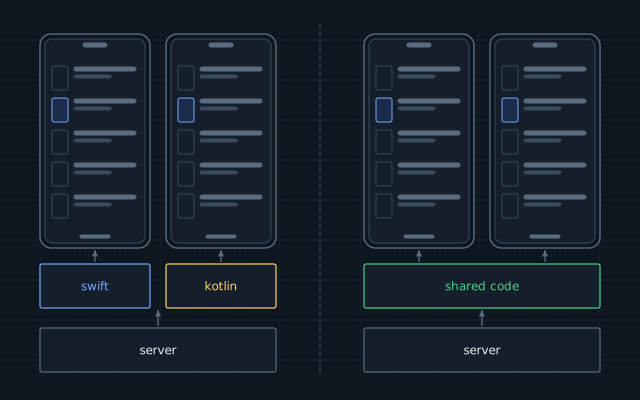
A mobile application for both iOS and Android can be written twice, or once with a shared code base. Neither answer is correct in general. The right one depends on what the application has to do and how long it has to live.
The options
Native means Swift for iOS and Kotlin for Android, with two code bases. You get full access to the platform and new system features on the day they ship.
Flutter shares both interface and logic, written in Dart. It draws its own widgets, so the application looks the same on both platforms.
React Native shares code written in JavaScript or TypeScript and renders real platform components. It suits teams that already work in React.
Kotlin Multiplatform shares business logic and leaves the interface native. You keep the platform’s look and avoid writing the rules twice.
Where shared code wins
Shared code is the sensible choice for most business applications: forms, lists, catalogues, accounts and payments. One team, one set of tests and one release schedule usually mean lower cost, and features arrive on both platforms together.
Where native wins
Choose native when the application depends on:
- heavy graphics or custom camera processing;
- deep integration with hardware or background services;
- platform conventions that users notice when they are wrong;
- system features you need as soon as they are released.
The costs people forget
Plugins. Anything the shared framework does not cover needs a plugin or native code. Check the plugins you depend on: who maintains them, and how quickly they follow new system versions.
System updates. Apple and Google change requirements every year. A native application adjusts through its own SDK. A shared one waits for the framework and then for its plugins.
Debugging. When something fails between the shared layer and the platform, you need someone who understands both.
Hiring. Check who will maintain the application in five years, and whether you can find those people.
How to decide
List the ten most important functions of the application and mark each one that needs direct access to the device. If only one or two are marked, shared code will probably serve you well. If most are marked, the savings will be spent on workarounds.
Whatever you choose, keep business rules on the server where you can. A rule that lives on the server changes for everyone at once, with no store review and no waiting for users to update.
Scritto dal team di ingegneria di Avtim. Sono informazioni generali; verificatele sul vostro sistema prima di farvi affidamento.